

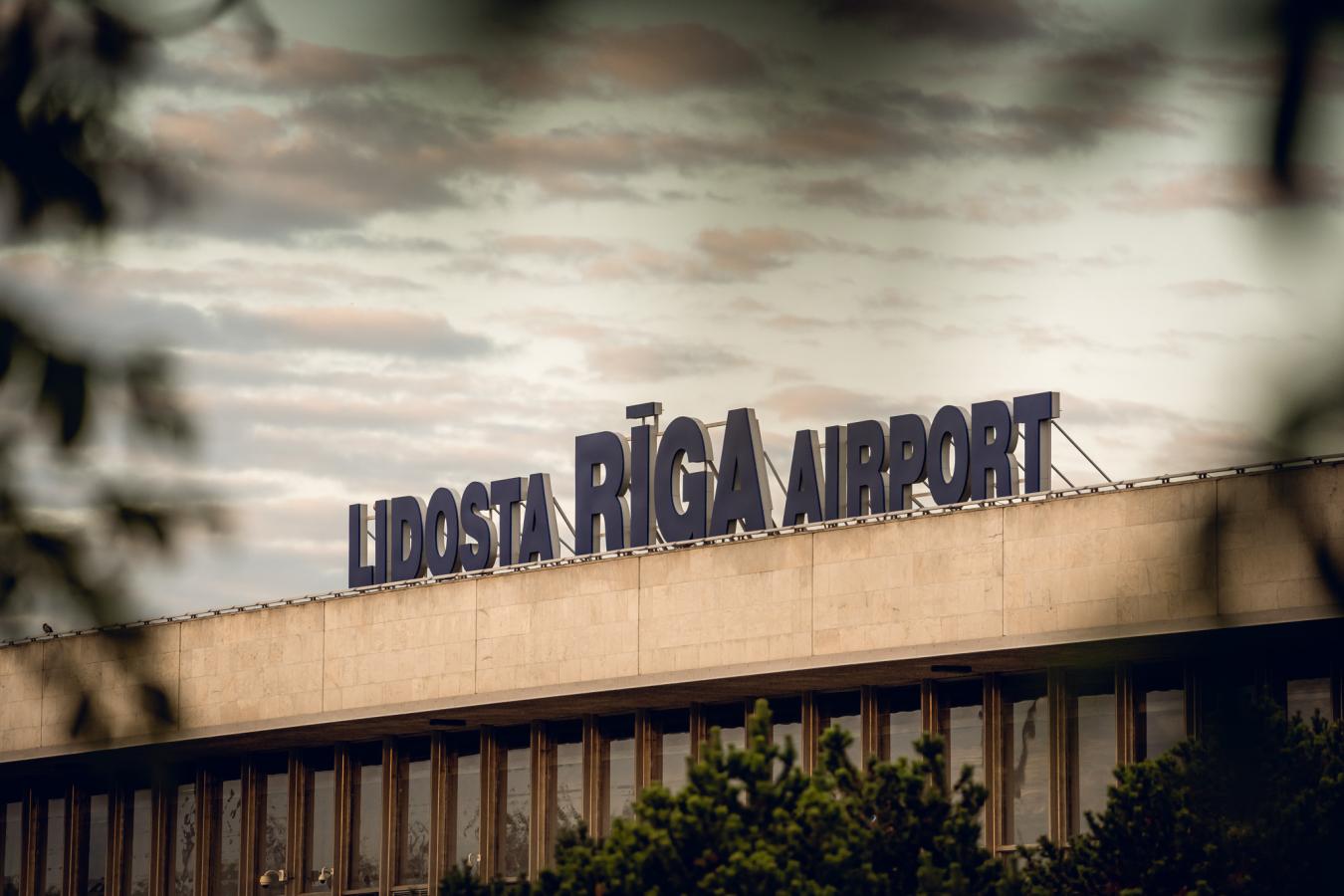
Riga Airport is a state-owned company. Its sole owner is the Republic of Latvia. The shares on behalf of the state are held by the Ministry of Transport of the Republic of Latvia. The official name of the airport is "State joint-stock company (SJSC) Riga International Airport".
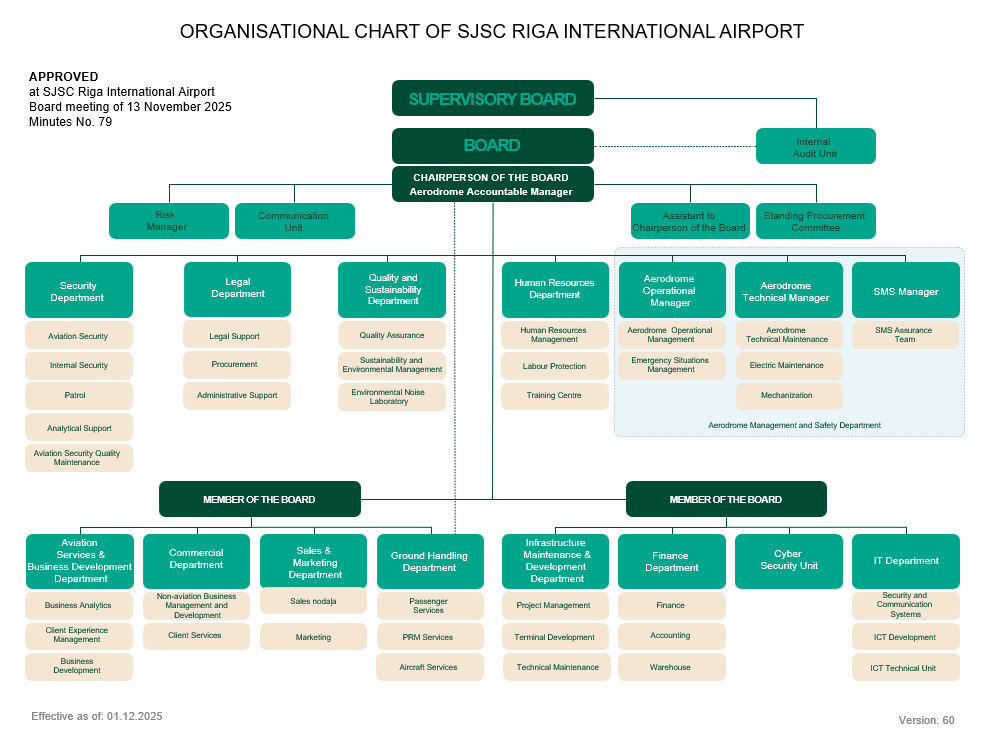
The board is the executive body of the airport, which manages and represents the company. The board organizes and ensures the operation of the airport and is responsible for the fulfillment of the tasks assigned to the company. Board members manage and represent the company jointly.
Board members
Chairperson of the Board Laila Odina

Laila Odiņa, the Chairperson of the board of Riga Airport, has been re-confirmed in her position from April 16, 2026.
Term of office: 5 years
|
Work experience: Laila Odiņa has been a member of the board of Riga Airport, a member of the Board of the Institute of Transport and Communications, the director of operational management of "UTAir Airlines", the executive director of "Azerbaijan Airlines", as well as the director of operational management of JSC "Air Baltic Corporation". Education: City University London - Pg Air Transport Management University of Business, Arts and Technology "RISEBA" - business management Positions in other capital companies: None |
Board member Normunds Feierbergs

Normunds Feierbergs, member of the board of Riga Airport, has been re-confirmed in his position from November 10, 2021.
Term of office: 5 years.
|
Work experience Normunds Feierbergs has been a member of the board of Riga Airport since November 10, 2016. Previously, he was the head of Information Technology Department, vice president of JSC "Latvijas Krājbanka" and the head of General Banking Services Department, first vice president of JSC "UniCredit Bank", as well as held other leading positions in various companies. Education Faculty of Economics and Management of the University of Latvia, master's degree in business management Faculty of Physics and Mathematics of the University of Latvia, bachelor's degree in computer science Positions in other capital companies: Member of the council of State Joint Stock Company "Latvijas Valsts radio un televīzijas centrs". |
Board member Arturs Saveljevs
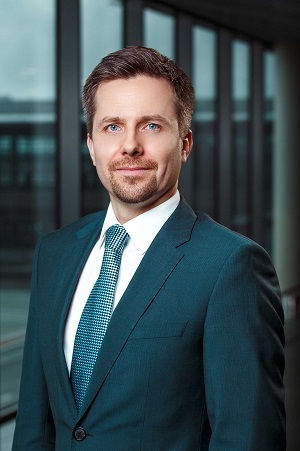
Artūrs Saveļjevs, member of the board of Riga Airport, has been re-confirmed as a member of the board from September 12, 2022.
Term of office: 5 years.
|
Professional work experience Artūrs Saveļjevs is a member of the board of Riga Airport since September 12, 2017, a guest lecturer at Cranfield University and Transport and Communications Institute, as well as the chairman of the Commercial Forum of ACI Europe. Previously, he was also director of the Commercial and Marketing Departments of Riga Airport, head of non-aviation marketing, as well as director of the Professional Master's program "Aviation Management" of Transport and Communications Institute. Education Cranfield University, MSc in Airport Planning and Management University of Latvia, Master's Degree in Economics (International Economics) Riga International University of Economics and Business Administration, professional bachelor's degree in business management. Positions in other capital companies: None |
The Supervisory Board is the supervisory body of the Riga Airport, which represents the interests of the representative (state) of the holder of the state's capital shares between shareholders' meetings and supervises the activities of the company's board within the framework specified in the regulatory acts and the Airport's strategy.
Supervisory Board Members
Chairman of the Supervisory Board Juris Kanels
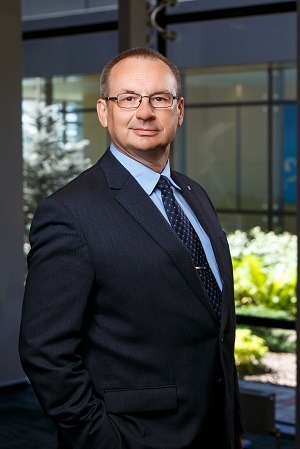
Member of the Supervisory Board Elīna Salava

Riga Airport is a state joint-stock company of the Republic of Latvia, and the holder of its state capital shares is the Ministry of Transport of the Republic of Latvia.
Riga International Airport is a member of several organizations:
ACI EUROPE – Airports Council International Europe
LPVA – Latvian Association of Personnel Management
LDDK – Employers’ Confederation of Latvia
Mārupes uzņēmēji – Society “Mārupes uzņēmēji” (“Mārupe Antrepreneurs”)
LTRK – Latvian Chamber of Commerce and Industry
LAA - Latvian Aviation Association
FSDI Latvia - The Federation of Security and Defence Industries of Latvia
LVH2 - Latvian Hydrogen Alliance
IIA - Latvian Institute of Internal Auditors
Business Sustainability Council
Innovative State Companies Initiative
Riga Airport holds five key ISO certifications, demonstrating its commitment to continuous improvement and providing the highest quality services to passengers, partners, and employees. These certifications cover quality, environmental protection, energy efficiency, information security, and occupational health and safety.
ISO 9001: Quality Management System
This standard ensures that the organization consistently delivers high-quality services that meet customer needs. It focuses on customer satisfaction, process optimization, and continuous improvement, making it a fundamental part of the airport’s management system.
ISO 14001: Environmental Management System
ISO 14001 helps organizations reduce their environmental impact by providing a framework for managing and improving environmental performance. It supports sustainable practices, efficient resource use, and waste reduction.
ISO 50001: Energy Management System
This certification enables organizations to monitor and improve energy efficiency, reduce greenhouse gas emissions, and minimize overall energy consumption. It underscores a commitment to sustainability through effective and responsible energy use.
ISO 27001: Information Security Management System
In response to growing concerns over data protection and cybersecurity, ISO 27001 confirms that the organization meets the highest standards for information security and risk management. It focuses on safeguarding personal and operational data, ensuring secure handling and storage of sensitive information.
ISO 45001: Occupational Health and Safety Management System
This certification demonstrates the airport’s commitment to protecting employee health and safety. It provides a structured approach to reducing workplace risks, ensuring safe working conditions, and preventing accidents and incidents.